
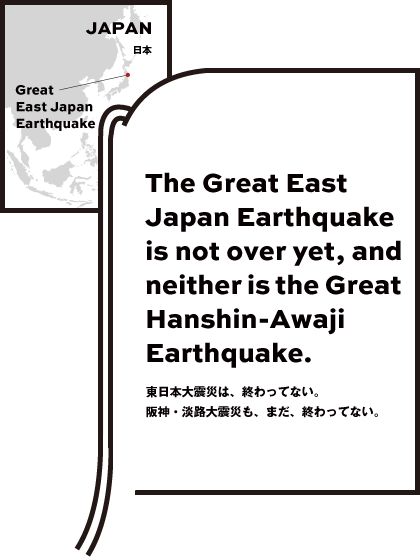
 The Great East Japan Earthquake is not over yet, and neither is the Great Hanshin-Awaji Earthquake.
-

- 災害発生前
- デザイン
- SPREAD
- Designer
- Design and Creative Center Kobe + 36 volunteers
- The Great Hanshin-Awaji Earthquake +Creative Timeline Mapping Project
Studing a past disasters to prepare us for
future disasters
After the Great East Japan Earthquake, Hirokazu Kobayashi and Haruna Yamada of SPREAD asked the question: “What can creators do for the post-quake recovery?” The question provided a spark for them to launch the Great Hanshin-Awaji Earthquake + Creative Timeline Mapping Project (TM Project).
The TM Project was opened to the public in November 2011. In the project, they conducted research on how support was provided in the fields of art, design, and architecture after the Great Hanshin-Awaji Earthquake. Then, while presenting information on their research results, they encouraged creators, who would assist in the post-quake recovery, to determine what was necessary and what was missing at each point during the recovery process.
Why did the two members of SPREAD conduct research on the Great Hanshin-Awaji Earthquake? At first, they planned to draw up guidelines for the recovery activities of creators after the Great East Japan Earthquake. However, when Hirokazu Nagata, Vice Director of Design and Creative Center Kobe, was asked for feedback on their idea, he pointed out that it might cause a misunderstanding to provide guidelines for recovery efforts from the Great East Japan Earthquake based on there ideas, because they could not see the progress of recovery at that time.
Accordingly, they started with research not on the earthquake that they were then faced with, but on past earthquakes, and explore what they could do based on the results of such research. Thus, the TM Project is carried out to promote the relief efforts of creators.
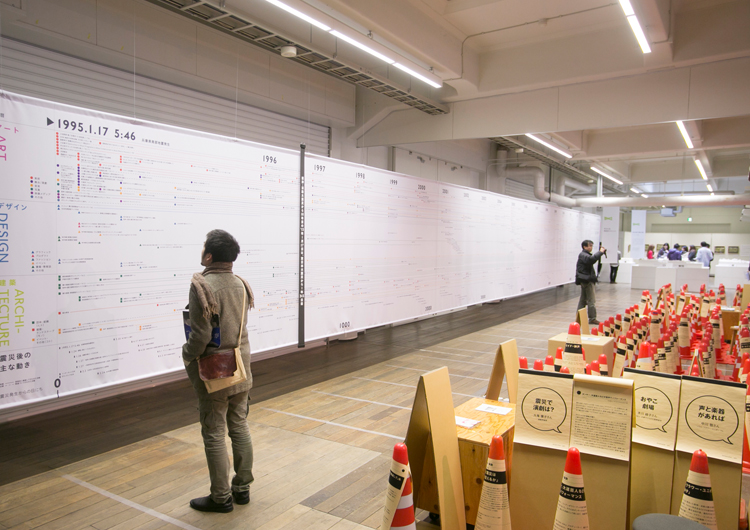
- Exhibition held at Design and Creative Center Kobe in January 2013
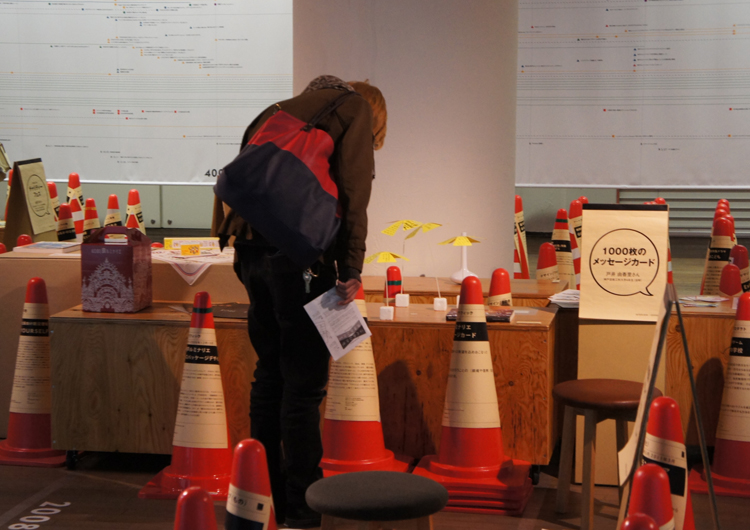
- Exhibition held at Design and Creative Center Kobe in January
2013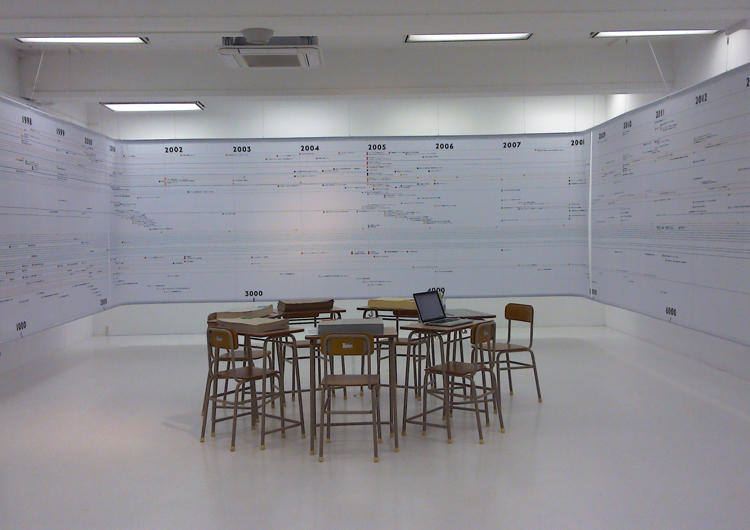
- Exhibition held in Tokyo in 2013
A timeline presents the past and
the future at a glance
The Timeline Mapping shows the recovery assistance for the Great Hanshin-Awaji Earthquake according to timeline (time axis), as referred to in the title. This map is drawn using a method employed in an art work called “Life Stripe”, in which the two members of SPREAD have been involved since 2005 to record people’s behavioral patterns in a day along a time axis of 24 hours by replacing them with 21 colors. The concept of Life Stripe is to enhance people’s awareness of what lives they will live in the future by reviewing their behavioral patterns in a day through expressing them using bands of colors. This concept overlaps with that of the TM Project, which says that we should look back at the past earthquake to apply what we have learned to the future.
On the website of the TM Project, a timeline map is displayed with lines extending vertically, which show how many years and days have passed since the Great East Japan Earthquake. When overlaying the time period of two and a half years from the Great East Japan Earthquake on a timeline chart over 18 years from the Great Hanshin-Awaji Earthquake, we can see that we still have a long way to achieve the recovery from the earthquake and that there are still many things for us to do.
The timeline map enables us to see not only creative activities in the fields of art, architecture, and design during the same period after both earthquakes but also the past, present, and future at a glance.

- “Life Stripe” created by SPREAD. Patterns of lifestyles recorded
for 24 hours by replacing behavioral patterns in a day with 21 colors
- Timeline map for the Great East Japan Earthquake that SPREAD planned to draw at first. It was an imaginary map, though people said that it was easy to read
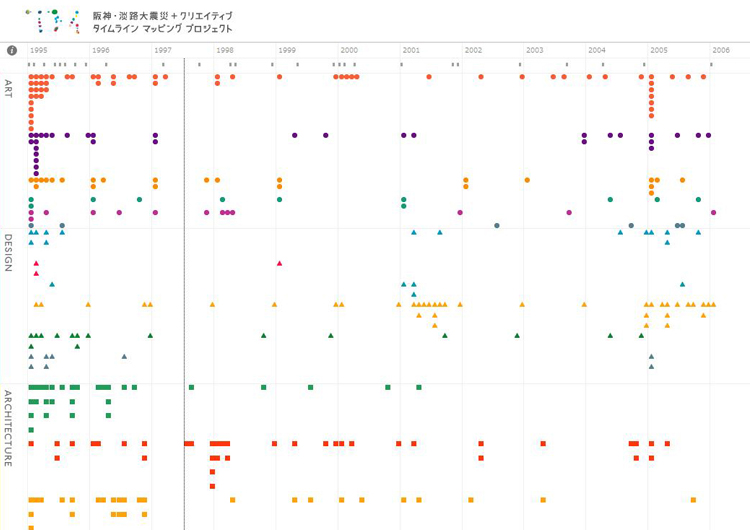
- Timeline map of the TM Project that shows how many years and days have passed since the Great East Japan Earthquake
Efforts for the future also preserve memories
of the past
The activities in the TM Project include timeline mapping and summary reports of individual activities, interviews, and details of what staff members have learned, as well as various other contents. Research activities are conducted by 40 volunteer staff members consisting of residents of Kobe City and students who gathered in response to an invitation from Design and Creative Center Kobe, the secretariat of the project.
When the two members of SPREAD, who did not experience the Great Hanshin-Awaji Earthquake, held a kickoff meeting of this project in Kobe, volunteer participants talked about their experiences as disaster survivors and the younger generations that had not experienced any disaster said that they would like to do something as residents living in affected areas. Listening to their words, the two members of SPREAD realized again that the Great Hanshin-Awaji Earthquake had not ended.
To investigate information on the Great Hanshin-Awaji Earthquake, which occurred 18 years ago when the Internet was still not so prevalent, the staff members had to energetically move around, including consulting reference materials directly at universities and specialized institutions and looking for those involved in the earthquake in order to conduct interviews. The participation of residents in Kobe City and students was very important for these research activities.
As 18 years have passed since the Great Hanshin-Awaji Earthquake, there have been extremely few opportunities to look back on the earthquake in Kobe except on each January 17, the memorial day for the earthquake. The TM Project will not only serve as guidelines for post-quake activities in the future but also as a tool for continuing to arouse the memories of disaster survivors in affected areas and hand down the lessons learned from the earthquake to the next generation.

- Kickoff meeting for the TM Project, where participants introduced themselves and explained why they had joined the project
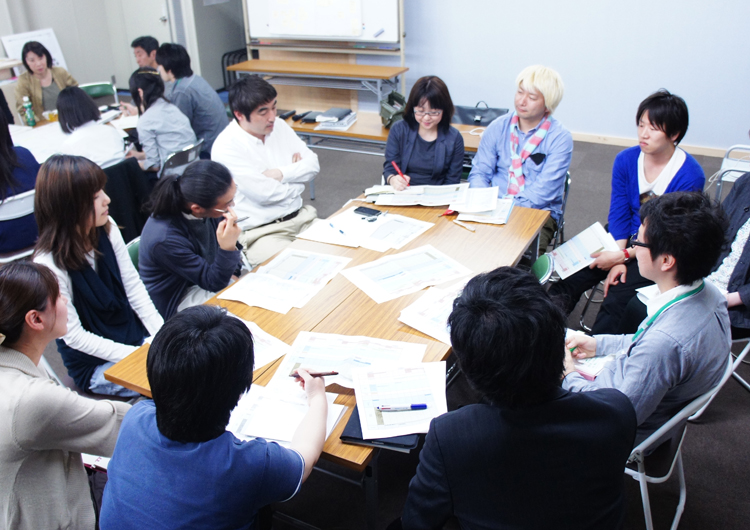
- The two members of SPREAD residing in Tokyo (center) came to Kobe as many times as possible to join meetings with volunteer members
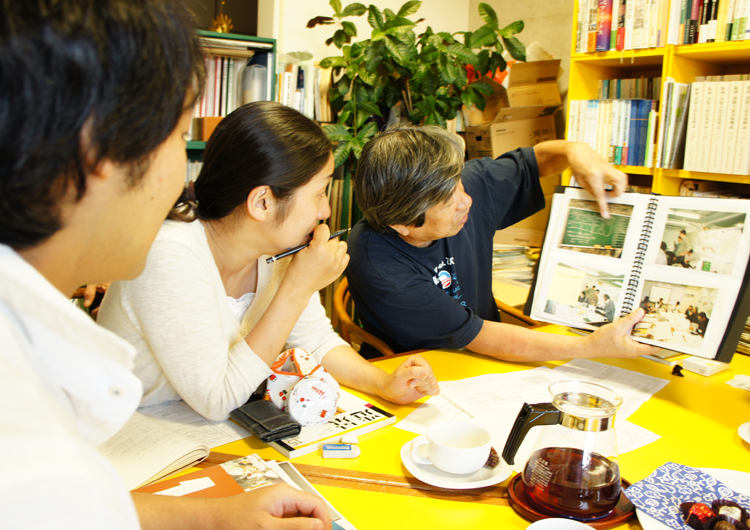
- Visiting a key person who actually engaged in support activities to interview him about the actual situation at that time